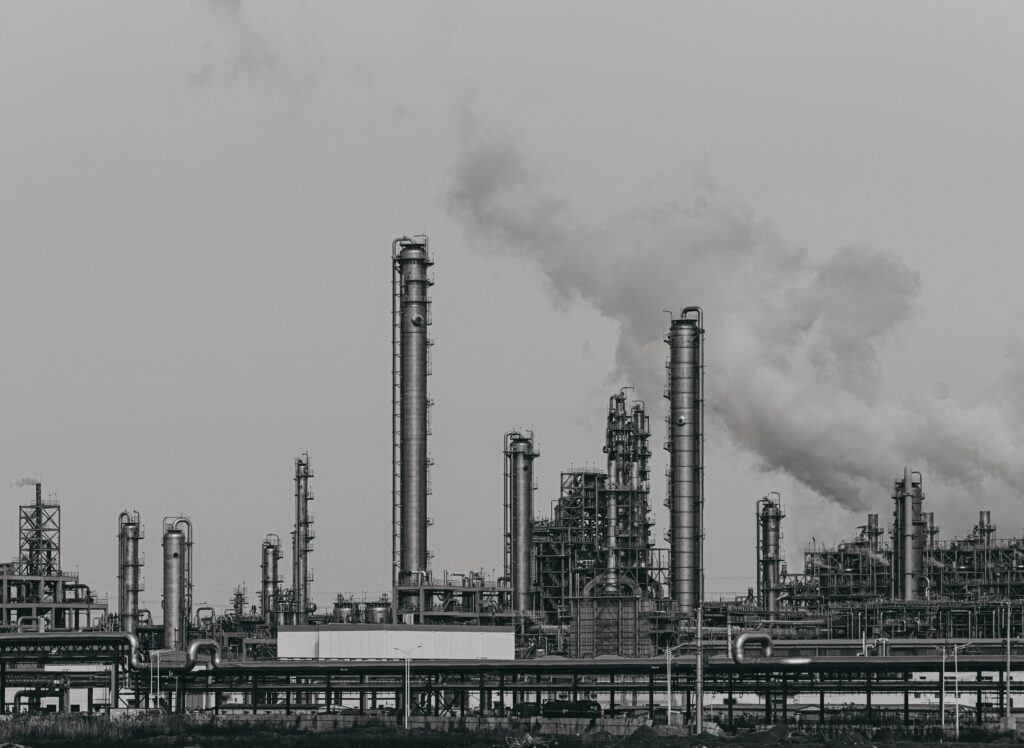
In a new preprint study, researchers at the Spatial Finance Initiative have quantified the committed CO₂ emissions associated with current and planned ethylene steam crackers using the Global Ethylene Production Database.
This open access database covers 342 petrochemical facilities worldwide and enables detailed analysis of production capacity, expansion trends and climate risks across the sector. It is part of the GeoAsset project and is freely available under a CC BY 4.0 license.
Key findings
The study highlights several important trends shaping the future of the petrochemical industry:
- Significant carbon lock-in: Existing ethylene production assets are expected to generate approximately 4.9 Gt CO₂ between 2025 and 2050, with a further 2.5 Gt CO₂ from planned and under-construction facilities, totalling 7.5 Gt CO₂ of committed emissions.
- Rapid capacity expansion: Global ethylene production capacity is projected to increase by around 25%, driven largely by new investments in Asia.
- Geographical concentration: China accounts for a large share of new capacity and is expected to become the world’s largest producer, reflecting a broader shift in petrochemical production towards Asia.
- Corporate concentration: A relatively small number of companies, particularly state-owned enterprises and major oil and gas firms, account for a substantial share of current and future emissions.
- Misalignment with climate goals: Ethylene production alone could consume over 30% of the chemical sector’s remaining 1.5°C carbon budget from 2025 onwards.
These findings demonstrate the critical importance of granular, asset-level data for understanding climate and financial risks in the petrochemical sector. By linking production assets to ownership and geography, the database enables more robust analysis of emissions trajectories, transition risks, potential stranded assets and more.