

Paper: Global Ethylene Production and Carbon Lock-In: Insights from Asset-Level Data
A new study introduces the first global, asset-level database of ethylene production and reveals significant carbon lock-in risks, with up to 7.5 Gt CO₂ emissions committed from existing and planned production capacity.

Unlocking Farm-Level Environmental Data to Support a Resilient Agricultural Sector
This article explores how improved use of farm-level data can enhance resilience in England’s agricultural sector. By enabling more granular analysis of environmental and financial risks, such data can support better decision-making, improve transparency and contribute to more sustainable and adaptive food systems.

Paper: A dual-workflow framework for evaluating pulp and paper industry impacts on nature
Read the paper The pulp and paper industry contributes to nature loss through multiple drivers across its value chain. Life Cycle Assessments (LCAs) have supported

Conference paper: Extracting structured information from technical specification PDFs using LLMs and RAG
Read the paper This paper presents an end-to-end artificial intelligence pipeline for extracting structured, asset-level information on data centres from unstructured technical specification PDFs. Addressing

Integrating Climate Risk for Financial Resilience: Reflections from the CGFI-Bank of England CP10/25 Event
At this year’s Building Societies Association (BSA) Annual Conference in Birmingham, the UK CGFI Leeds Innovation Hub, in collaboration with BSA, hosted a breakout session, ‘Communicating with customer on climate risk: barriers, motivations and opportunities for action’. This session aimed to explore how the sector can better support customers in understanding and responding to the increased risks of extreme weather events, such as flooding and overheating, resulting from the changing physical climate.
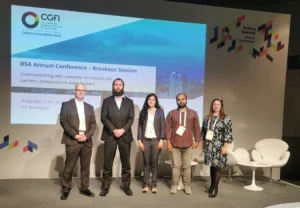
Communicating with Customers on Physical Climate Risk: Barriers, Motivations and Opportunities for Action
At this year’s Building Societies Association (BSA) Annual Conference in Birmingham, the UK CGFI Leeds Innovation Hub, in collaboration with BSA, hosted a breakout session, ‘Communicating with customer on climate risk: barriers, motivations and opportunities for action’. This session aimed to explore how the sector can better support customers in understanding and responding to the increased risks of extreme weather events, such as flooding and overheating, resulting from the changing physical climate.
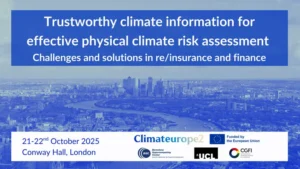
21st October – Trustworthy climate information for effective physical climate risk assessment (Climateurope2)
Climateurope2, UCL, and the UK Centre for Greening Finance and Investment will host a re/insurance and finance sector-focussed event on 21 and 22 October 2025, bringing together key players in the climate services market, to address central issues around quality, trustworthiness and regulation of climate services for re/insurance and finance.

CGFI at Oxford Sustainable Finance Summit
16-17th July 2025 | University of Oxford More information UK CGFI researchers shaped discussions in several sessions at Oxford Sustainable Finance Summit 2025, which took

Climate Investment Challenge 2025 Finale
CIC finalists pitched their innovative solutions in the CIC finale, with awards including the Data Analytics Prize for solutions applying data and analytics to climate/financial challenges.

CGFI Hackathon 2025 – Global characteristics of tropical cyclones: tropical risk analytics for the reinsurance industry – key takeaways
Our 2025 Hackathon brings together researchers and practitioners to investigate questions related to climate model data, and especially tropical cyclones, of relevance for the reinsurance industry (companies who insure insurers).
From research to application in the insurance industry – workshop findings
The UK Centre for Greening Finance & Investment (CGFI) convened a workshop in Leeds to explore how climate science can better inform decision-making in the insurance industry – read key takeaways

Webinar – Practitioners’ Insights: Climate Transition: Risks and Opportunities
This CFA Institute webinar with CGFI’s Head of Transition Finance Research, Dr Gireesh Shrimali, provides an overview of the climate transition and highlights these principles in the investment process.
Paper: Global Ethylene Production and Carbon Lock-In: Insights from Asset-Level Data
A new study introduces the first global, asset-level database of ethylene production and reveals significant carbon lock-in risks, with up to 7.5 Gt CO₂ emissions committed from existing and planned production capacity.
Unlocking Farm-Level Environmental Data to Support a Resilient Agricultural Sector
This article explores how improved use of farm-level data can enhance resilience in England’s agricultural sector. By enabling more granular analysis of environmental and financial risks, such data can support better decision-making, improve transparency and contribute to more sustainable and adaptive food systems.
Paper: A dual-workflow framework for evaluating pulp and paper industry impacts on nature
Read the paper The pulp and paper industry contributes to nature loss through multiple drivers across its value chain. Life Cycle Assessments (LCAs) have supported
Conference paper: Extracting structured information from technical specification PDFs using LLMs and RAG
Read the paper This paper presents an end-to-end artificial intelligence pipeline for extracting structured, asset-level information on data centres from unstructured technical specification PDFs. Addressing
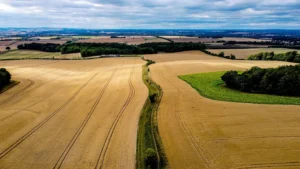
Paper: A Field-Level Asset Mapping Dataset for England’s Agricultural Sector
The agricultural sector is a major contributor to greenhouse gas emissions, yet the lack of asset-level farm data, including ownership, land use, and production, hinders effective transition finance and decarbonisation efforts. To address this gap, we developed an open-source farm-level dataset using natural language processing (NLP) and unsupervised learning, mapping farm names to spatial polygons to fill ownership and entity gaps. In England, this approach identified 117,116 farming entities.

Who pays? Money, power and risk in sustainable finance
Read here The March 2025 issue of environmental SCIENTIST – the journal of the Institution of Environmental Sciences –considers how we can harness finance to